
Nobody learns to use AI from a manual
When spreadsheets arrived in offices thirty years ago, companies sent people to training rooms. An instructor, a projector, a binder. Everyone learned the same formulas in the same order, and by Friday most of it was forgotten.
AI does not work that way. And the way people learn to use it should not either.
At efficy Group, when leadership decided to make Claude available to every employee, the internal pulse survey revealed something they had suspected but never measured: 80% of people were already using AI tools every week. Not in the shadows, but openly, the way people naturally adopt what makes their work better. Testing prompts between meetings, comparing approaches over coffee, sharing shortcuts across teams. The curiosity was already there. The decision to deploy Claude company-wide turned that energy into a shared foundation.
But a foundation is not a culture. And the question that emerged next is one we suspect many organizations are quietly facing: when your people are already moving, what does the company build around them?
The answer came from the people themselves
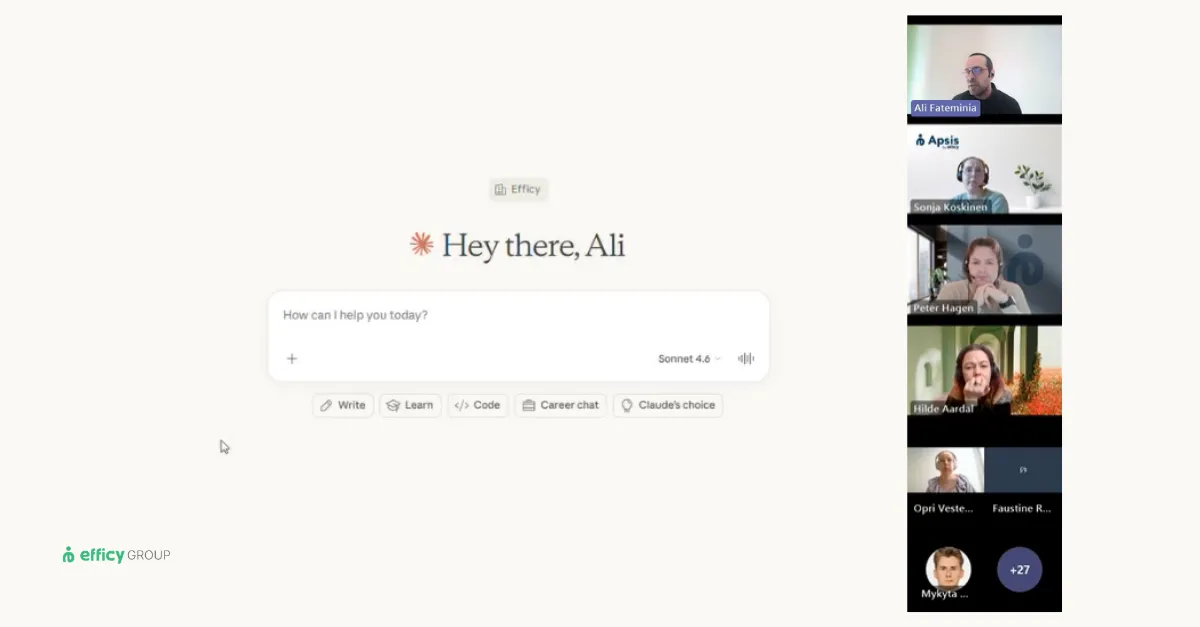
On March 26, Ali, Head of Tech in the Martech BU based in Malmö, ran a live session for colleagues across the group. No slides. Just his screen, his actual Claude Desktop setup, and an hour walking through how he uses it in his real work every day. Which models he picks for which tasks. How he has built connectors specifically for efficy tools. How he sets up persistent workspaces for recurring projects. The kind of practical knowledge that no documentation captures, because it lives in the habits someone builds over months of daily use.
More than thirty colleagues joined from multiple business units and countries. And then something happened that no program could have engineered: Rose, a Product Manager at Tribe, reached out the same day to share her own experience. She had been documenting her AI journey on a personal blog, writing about custom instructions and skills in a way that made them accessible to non-technical colleagues. Her framing was disarmingly simple: treat these like a cheat sheet you leave on the desk for a new colleague. You write it once, and the AI refers to it every time.
Two people, two different roles, two different business units, volunteering their knowledge on the same day. That is not a training program, that is a culture expressing itself.
Why this matters more than it looks
There is a version of AI adoption that looks like a rollout. A vendor presentation, a pilot group, a phased deployment calendar, a proficiency assessment at the end. It is orderly. It is measurable. And for a technology that changes how people think about their work, it is almost certainly insufficient.
The challenge with AI is that its value is deeply personal: a Head of Tech and a Product Manager will never use it the same way, and they should not. The best practices are not universal best practices. They are individual workflows refined through experimentation, shaped by the specific problems someone faces and the specific way they think.
That means the most valuable knowledge about AI at any company is distributed across the people who use it, not concentrated in a training department. And the fastest way to unlock it is to create the conditions where people share it willingly.
From informal to intentional
efficy Group made Claude available to every employee and built a structured learning path, Claude Fundamentals, for anyone who wanted a foundation. AI Ambassadors stepped up voluntarily across departments to share what they were discovering. An internal hub was created so nothing gets lost.
But the piece that was still missing was the live, unscripted moment where someone shows their screen and says: this is how I actually work.
That is what the AI Flash Sessions are. Starting in April 2026, they are a recurring format where one colleague, from any role, any business unit, any country, walks others through their real AI usage. No curriculum. No mandatory attendance. Just someone who has found something useful showing it to others who want to learn.
The format is deliberately lightweight. Because the moment you turn peer learning into a formal program with objectives and evaluations, you lose the thing that makes it work: the honesty of someone sharing what they actually do, including the parts that are messy or unfinished.
A different kind of challenge
An internal pulse survey showed that 89% of people at efficy Group say AI makes them more productive, and nearly half say it is changing how they approach their work entirely. The organizational challenge, then, is not adoption. It is accompaniment. How do you support a transformation that your employees are driving faster than any program could? How do you add just enough structure without killing the organic energy that got you here?
efficy Group’s answer, for now, is to keep making space. The Flash Sessions are not the end of that answer. They are the next step in a culture where learning moves at the speed of curiosity, not at the speed of curriculum design.
And if the first session is any indication, the next volunteer is probably already preparing their screen.
Learn more about our culture

