

Sovereign CRM: The Strategic Challenge for European Businesses
Amid a surge in cyberattacks, up 38% in Europe between 2023 and 2024 according to ENISA, and rising geopolitical tensions, digital sovereignty has become a top priority for business leaders.
Today, more than 90% of Western companies' data passes through servers located in the United States, exposing organizations to major legal and operational risks. The CRM (Customer Relationship Management) sector is no exception. American solutions dominate the European market, placing sensitive customer data under foreign jurisdiction.
📌 Key Takeaways
- A sovereign CRM guarantees that data is hosted and processed in Europe, strengthening GDPR compliance and control over sensitive information.
- Digital sovereignty is becoming a strategic issue to limit dependence on non-European solutions and secure customer data.
- Companies are now looking for CRM tools that combine security, transparency, and business performance without compromising the user experience.
- A sovereign CRM supports clearer data governance and reassures customers, partners, and IT leadership alike.
What Is Digital Sovereignty in a CRM?
Definition and Stakes
Digital sovereignty refers to an organization's ability to fully control its data and digital infrastructure, free from technological or legal dependence on foreign actors. In a CRM context, this means ensuring that customer data, often among a company's most sensitive assets, remains under the organization's exclusive control and protected by European law.
A sovereign CRM is not simply about hosting data geographically in Europe. It's a comprehensive approach encompassing data localization, legal governance, and operational control of the infrastructure.
The 3 Pillars of Digital Sovereignty
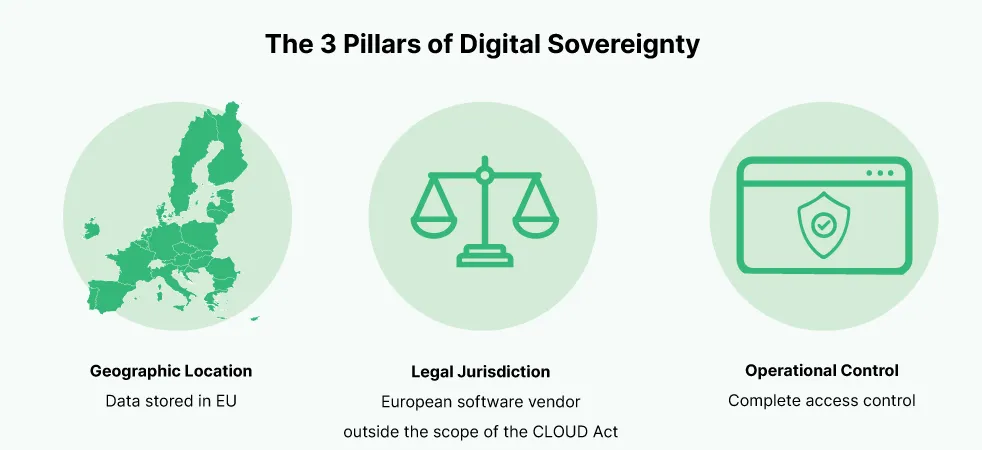
Pillar 1: Geographic Location
The first pillar concerns the physical location of the servers hosting your CRM data. A sovereign CRM ensures that all data is stored in data centers located in France or the European Union, with no possibility of transfer to third-country jurisdictions.
This localization must be:
- Transparent: The vendor must be able to provide the exact address of the data centers
- Permanent: No contractual clause should allow a transfer outside the EU
- Redundant: Backups must also remain in Europe
Pillar 2: Legal Jurisdiction
The second pillar is often the least understood, yet it's also the most critical. Having servers in Europe isn't enough on its own to guarantee protection. The vendor's nationality and ownership structure determine which legislation actually governs your data.
An American vendor, even with European servers, remains subject to the U.S. Cloud Act of 2018. This law allows U.S. authorities to demand access to data held by American companies, regardless of where that data is physically hosted.
To ensure genuine sovereignty, a vendor must:
- Be incorporated under European law
- Have majority European ownership
- Have no American subsidiary that could serve as a legal point of entry
Pillar 3: Operational Control
The third pillar concerns the technical and operational control of the infrastructure. A sovereign CRM solution must allow the company to:
- Control access: Who can view the data, and under what conditions?
- Audit operations: Full traceability of access and changes
- Guarantee portability: The ability to export and migrate data without technological lock-in
The difference between simple "European hosting" and true sovereignty lies in the combination of all three pillars. A CRM hosted in Europe by an American vendor is not a sovereign solution, because pillars 2 and 3 aren't satisfied.
The Risks of Non-Sovereign CRMs
GDPR, NIS2, DORA: The European Regulatory Framework
Europe's regulatory landscape around data protection and cybersecurity has tightened considerably in recent years. Understanding these regulations is essential to assessing the risks tied to your choice of CRM.
Comparison of the different regulations
| Regulation | Year | Sectors Affected | CRM Requirements |
|---|---|---|---|
| GDPR | 2017 | All sectors | Consent, portability, DPO, breach notification |
| NIS2 | 2024 | 11,500 companies in France (critical/important sectors) | Resilience, incident management, supply-chain security |
| DORA | 2025 | Financial sector only | Resilience testing, ICT third-party management, contractual clauses |
Choosing a sovereign CRM is no longer simply a matter of preference . It's a regulatory necessity for many sectors. Companies need to anticipate the ongoing tightening of Europe's regulatory framework and favor solutions that guarantee native compliance.
The Cloud Act: Real Threat or Overblown Fear?
Passed in March 2018, the Cloud Act is a U.S. federal law that extends American jurisdiction over data held by U.S. companies, regardless of where that data is physically located.
Practical implications for European companies
When a European company uses a CRM from an American vendor (Salesforce, HubSpot, Microsoft Dynamics, etc.), its data can be legally requisitioned by U.S. authorities without the company even being informed. The American provider is legally required to comply, even if doing so violates European GDPR rules.
Documented cases
In 2020, the Court of Justice of the European Union (CJEU) invalidated the Privacy Shield in the Schrems II, case, ruling that European citizens' data wasn't adequately protected in the United States against mass surveillance programs. That ruling highlighted the fundamental incompatibility between the Cloud Act and the GDPR.
More recently, in 2023, several European companies received formal notices from France's CNIL for unlawfully transferring data to the United States via American cloud tools.
Sectors Facing Particular Exposure
Healthcare: Critical Risk
The healthcare sector handles sensitive data protected by specific regulations. In France, hosting health data requires HDS (Hébergeur de Données de Santé) issued by ASIP Santé. A non-sovereign CRM exposes healthcare institutions to penalties and loss of patient trust.
Finance: Critical Risk
The financial sector is subject to the DORA (Digital Operational Resilience Act), which took effect in January 2025. This regulation imposes strict requirements on operational resilience and third-party provider management. Banks and financial institutions using non-sovereign CRMs risk sanctions from the ECB (European Central Bank) and operational restrictions.
Public Sector and Local Government: High Risk
The French government issued a trusted cloud doctrine in 2021, favoring solutions certified SecNumCloud by ANSSI. A local authority using a non-sovereign CRM may be denied access to certain public funding and risks administrative disputes.
Defense and Industry: High Risk
Companies working in defense or handling industrial trade secrets are particularly exposed to economic espionage. The Draghi report on European competitiveness (2024) notes that more than 80% of critical digital technologies used in Europe are imported, creating a dangerous strategic dependency.
Higher Education and Research: Moderate Risk
Higher education institutions manage students' personal data (often minors) as well as sensitive research work.
Business Benefits of Digital Sovereignty
Beyond regulatory compliance, choosing a sovereign CRM delivers concrete benefits for the business.
Table: Sovereignty Benefits by Function
| Function | Sovereign CRM Benefits | Requirements |
|---|---|---|
| CIO (Chief Information Officer) | Simplified compliance, fewer audits, better-controlled architecture | -40% of time spent on compliance. Estimated savings: €50-80K/year for a mid-sized company |
| DPO (Data Protection Officer) | Native GDPR control, full traceability, no out-of-EU transfers to manage | Zero CNIL formal notices. Savings: avoided fines (up to 4% of revenue) |
| CFO (Chief Financial Officer) | Lower compliance costs, avoided fines, better budget predictability | Positive ROI from year 2. +25% ROI over 3 years vs. a U.S. CRM |
| Executive Management | Competitive edge (tenders), brand image, strategic independence | +15% win rate on public tenders. Commercial differentiation |
| Sales Leadership | Sales argument (customer trust), reassuring compliance for B2B prospects | +12 points customer NPS. Sales cycle reduced by 15% (regulated sectors) |
| Legal Department | Legal security, reduced litigation risk, simpler contracts | -60% of time spent on GDPR clauses. Reduced exposure to class actions |
The 11 Criteria of a Sovereign CRM: Evaluation Grid
To determine whether a CRM is genuinely sovereign, you need an objective evaluation grid based on technical, legal, and organizational criteria.
Test Your CRM's Sovereignty (100 points)
HOSTING (30 points)
☐ Data hosted in France/EU (10 pts)
☐ ISO 27001-certified data centers (5 pts)
☐ Geographic redundancy within the EU only (5 pts)
☐ Hosting contract under French law (10 pts)
VENDOR (25 points)
☐ Company incorporated under European law (10 pts)
☐ European ownership >50% (10 pts)
☐ No U.S. subsidiary (5 pts)
TECHNOLOGY (20 points)
☐ Auditable source code (10 pts)
☐ No dependence on U.S. cloud providers (AWS, Azure, GCP) (10 pts)
LEGAL (25 points)
☐ Outside the Cloud Act's reach (15 pts)
☐ SecNumCloud/HDS certifications (10 pts)
Interpreting Your Score
- 90-100 points: Fully Sovereign CRM ✅ Your solution meets all sovereignty criteria. You're protected from the Cloud Act and compliant with the highest regulatory standards.
- 70-89 points: Partial Sovereignty ⚠️ Your CRM has some weaknesses. Identify the missing criteria and assess the associated risks.
- Moins de 70 points : Insufficient Sovereignty ❌ Your solution doesn't guarantee genuine sovereignty. You're exposed to the Cloud Act and to regulatory non-compliance risks.
5 Questions to Ask Your CRM Vendor
To apply this evaluation grid, here are the five essential questions to ask:
- "Exactly where is my data hosted? (city, country, name of the data center)"
- "What is the nationality of your company and of your majority shareholders?"
- "Do you use American cloud services (AWS, Azure, GCP) for your infrastructure?"
- "Can you contractually guarantee that no data will be transferred outside the EU?"
- "Do you hold ISO 27001, SecNumCloud, or HDS certifications?"
If your vendor can't provide precise answers to these questions, your digital sovereignty is compromised. It then becomes necessary to consider migrating to a sovereign CRM to regain control of your data.
Geo-repatriation: When Bringing Data Home Becomes Urgent
Geo-repatriation describes the process of bringing digital data back from servers located abroad to infrastructure based on national or European soil.
Why companies are geo-repatriating their CRMs:
- Regulatory compliance: New European directives (NIS2, DORA) impose strict data localization requirements for critical sectors
- Risk reduction: Avoiding exposure to extraterritorial laws (Cloud Act) and foreign surveillance programs
- Competitive advantage: Public procurement and certain regulated sectors now require sovereign solutions in their tenders
How Efficy Guarantees Your Digital Sovereignty
Efficy, a leading European CRM group, places digital sovereignty at the heart of its offering.
A Solid European Origin
Founded in 2005 and headquartered in Brussels, Efficy is a 100% European group with majority European ownership. This independence from American tech giants ensures your data stays under European jurisdiction.
Transparent Hosting in France
Efficy commits to hosting data exclusively in France, in partnership with trusted French providers. The data centers used are located on French soil and certified to the highest security standards.
Location transparency
Unlike many vendors who remain vague about the exact location of their servers, Efficy contractually commits to hosting in France, with a clause prohibiting transfers outside the European Union.
Security Certifications
Efficy is certified ISO/IEC 27001:2022 and ISO/IEC 27701, two internationally recognized standards for information security and privacy management.
🎯 Want to assess your current CRM's sovereignty?
Our experts are available to carry out a free audit and guide you through your transition to a sovereign solution.
FAQ: Digital Sovereignty and CRM
What is a sovereign CRM?
A sovereign CRM is a customer relationship management solution that guarantees three cumulative conditions:
- Localization: Data is hosted exclusively in France or the European Union
- Jurisdiction: The vendor is a company under European law, out of reach of the U.S. Cloud Act
- Control: The company has full control over its data, with contractual guarantees against transfer
Simple "hosting in Europe" isn't enough: if the vendor is American, the data remains subject to the Cloud Act.
Why choose a European CRM over an American one?
The main reasons are:
- Legal protection: A European CRM protects your data from the Cloud Act and from American surveillance programs (NSA, FISA)
- Regulatory compliance: Greatly eases compliance with GDPR, NIS2 and DORA
- Strategic autonomy: Avoids dependence on foreign providers who could unilaterally change their terms
- Competitive advantage: Becomes a differentiating criterion in public tenders and regulated sectors
- Customer trust: Reassures B2B customers concerned about protecting their data
How does a sovereign CRM protect customer data?
A sovereign CRM offers several layers of protection:
1. Legal protection:
- Data subject solely to European law (GDPR)
- Out of reach of the Cloud Act and other extraterritorial laws
- Contractual clause preventing transfer outside the EU
2. Technical protection:
- Data encryption in transit (HTTPS/TLS) and at rest (AES-256)
- Strong authentication and granular access management
- Audit trails: full traceability of all access and changes
- Encrypted, redundant backups (EU-only)
3. Organizational protection:
- ISO 27001 certification guaranteeing secure processes
- Regular penetration testing
- Business continuity and disaster recovery plans
- Support teams trained on GDPR
4. Contractual protection:
- Liability clause in case of a data breach
- Commitment to exclusive data localization
- Right of audit for the customer
- Guaranteed data portability
French vs. American CRM: what's the real difference?
Beyond geographic hosting, the differences between a French (or European) CRM and an American CRM are significant and directly impact your business:
1. Legal differences
| Aspect | American CRM | French/European CRM |
|---|---|---|
| Applicable law | Cloud Act (U.S. access to data) | European law (GDPR) |
| GDPR protection | Partial (risk of conflict with the Cloud Act) | Full |
| Legal recourse | U.S. jurisdiction (complex and costly) | French/European jurisdiction |
2. Operational differences
| Aspect | American CRM | French/European CRM |
|---|---|---|
| Customer support | Often offshored, U.S. time zones | Local, native-language teams |
| Customization | Standardized (global template) | Tailored to local specificities |
| Integrations | U.S. ecosystem (QuickBooks, etc.) | Local European ecosystem (Sage, Cegid, etc.) |
3. Strategic differences
| Aspect | American CRM | French/European CRM |
|---|---|---|
| Public tenders | Increasingly disqualifying criterion | Competitive advantage |
| Brand image | Perceived as "U.S. dependency" | Valued for sovereignty |
| Geopolitical risk | Exposure to sanctions, extraterritorial law | Protection amid international tensions |
Conclusion
- Digital sovereignty is no longer a theoretical concept reserved for cybersecurity experts. It has become a strategic and regulatory imperative for every European business. Choosing a sovereign CRM reflects a long-term vision of data protection, regulatory compliance, and strategic independence.
- As geopolitical tensions intensify and Europe's regulatory framework tightens (GDPR, NIS2, DORA), companies that anticipate this shift and choose sovereign solutions are positioning themselves favorably for the future. They avoid legal risks, secure their customer data, and gain a commercial edge.
- As a European CRM player, Efficy embodies this vision of sovereignty: hosting in France, top-tier security certifications, and a contractual commitment to data protection. For companies looking to regain control of their data, moving to a sovereign CRM isn't just a compliance matter. It's an investment in their autonomy and competitiveness.

