

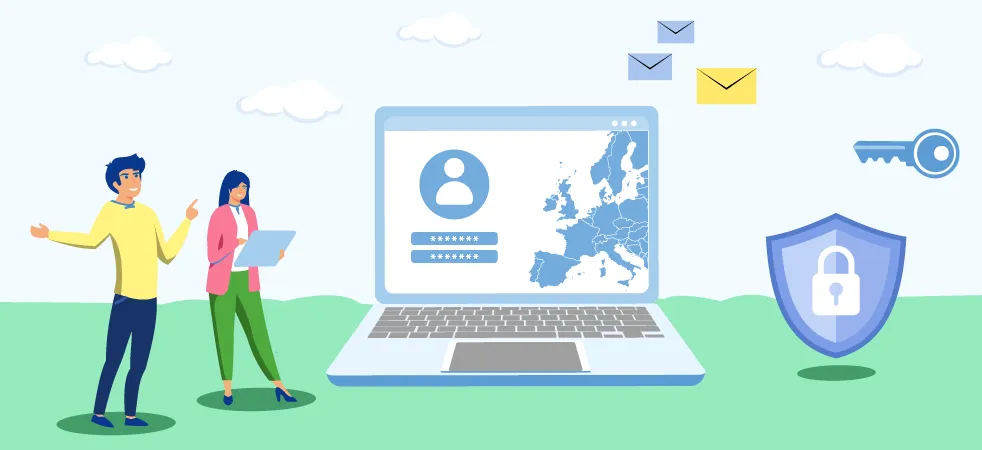
Digital Sovereignty and CRM: Taking Back Control of Your Customer Data
Why European companies need to take back control of their customer data.
Digital sovereignty applied to CRM refers to a company's ability to retain full control over its customer data: where it is hosted, who can access it, and under which law it falls. For a European company, this means choosing a CRM hosted in Europe and published by a company subject solely to European law, shielded from extraterritorial legislation.
Why has digital sovereignty become a strategic issue?
The rise of the cloud, the entry into force of the GDPR, the adoption of the U.S. Cloud Act, and growing cybersecurity requirements have turned digital sovereignty into a key selection criterion for business software. For European companies, CRM is particularly exposed, since it centralizes customer data, contracts, business communications, and sometimes sensitive information.
📌 Key Takeaways
- For a CRM, sovereignty isn't just about hosting: it's the vendor's nationality that determines which law governs your customer data.
- A CRM published by a non-European company can fall under extraterritorial law such as the Cloud Act, even when its servers are located in Europe.
- Europe's dependence on American providers remains massive, and the risk of GDPR non-compliance now runs into hundreds of millions of euros in fines.
- The answer comes down to three conditions: hosting in Europe, a European vendor, and guaranteed data reversibility.
CRM Sovereignty: What Are We Talking About?
Digital sovereignty has moved from an expert debate to a boardroom priority. The reasons: structural dependence on non-European technology providers, rising geopolitical tensions, and an increasingly demanding regulatory framework. CRM sits at the heart of this issue, since it concentrates a company's most sensitive data, that of its customers and prospects.
For an executive, CRM digital sovereignty isn't a technical topic. It's a risk topic: legal risk tied to extraterritorial laws, operational risk from dependence on a single vendor, financial risk from unilateral price increases, and reputational risk in case of non-compliance. Choosing a sovereign CRM, hosted in Europe and published by a European company, means taking back control of this strategic asset.
What Does Digital Sovereignty Mean for a CRM?
Digital sovereignty refers to an organization's ability to retain control over its data, its systems, and its technology choices, without depending on decisions made outside its jurisdiction. Applied to CRM, it guarantees that customer data, often among a company's most sensitive assets, stays under the organization's exclusive control and is protected by European law.
Sovereignty is too often reduced to a simple matter of geographic location. That's a mistake. Location is just one link in a longer chain that combines legal, technical, and contractual factors. A server can be physically installed in France while still being subject to a foreign law, simply because of the vendor's or host's nationality.
A genuinely sovereign CRM rests on four complementary pillars:
- Hosting: where the data is physically stored (a CRM hosted in France provides a first level of assurance).
- The vendor's jurisdiction: which law applies to the company that publishes and operates the solution.
- Encryption and access: who holds the keys and can technically access the data.
- Reversibility: the ability to retrieve your data and switch providers without being locked in.
It's the combination of all these pillars that defines a sovereign CRM, not the hosting location alone.
83% of cloud and business software spending in Europe is captured by American companies
Source: Asterès study for Cigref (2025)
The Real Risk: Cloud Act vs. GDPR
The heart of the matter isn't where the data resides, but who is legally entitled to demand access to it. That's where a CRM's sovereignty is truly decided, and it's where a major conflict of laws arises for European companies.
A server located in France does not guarantee that data is protected solely by French law.
What the GDPR Guarantees
The General Data Protection Regulation remains the foundation of personal data protection in Europe. It strictly regulates the collection, processing, and above all the transfer of data outside the European Union. A GDPR-compliant CRM must document where data is hosted, on what legal basis it is processed, and how individuals' rights are respected. Failing to comply exposes companies to heavy penalties: in 2025, France's CNIL issued €486.8 million in fines, including €325 million against Google and €150 million against Shein (source: CNIL, 2025 sanctions report).
What the Cloud Act Allows
Enacted in the United States, the Cloud Act allows U.S. authorities to require an American company to grant access to data it holds, even when that data is hosted outside the United States. In practice, a CRM published by a company incorporated under U.S. law can be subject to this obligation, even if its servers are located in Europe. The problem the Cloud Act poses for a CRM is therefore jurisdictional before it is geographic: it's the vendor's nationality that exposes customer data, not just where it's stored.
This conflict between the GDPR, which protects individuals' rights, and extraterritorial laws like the Cloud Act, which govern data access, leaves European companies in a state of legal uncertainty. Choosing a GDPR-compliant CRM hosted in France and published by a European company is today the safest way out of this grey zone.
Digital Sovereignty and CRM: 4 Misconceptions to Know Before Choosing a Solution
Digital sovereignty is a complex topic, often surrounded by misconceptions. Here are the most common ones.
"If my data is hosted in France, my CRM is automatically sovereign."
❌ False. Hosting provides a first layer of protection, but it isn't enough. If the CRM vendor is subject to extraterritorial legislation, such as the U.S. Cloud Act, certain authorities can request access to the data even when it's stored in Europe.
"The GDPR fully protects my data against foreign laws."
❌ False. The GDPR governs the collection, processing, and transfer of personal data. It doesn't neutralize the obligations a vendor under a foreign jurisdiction may be subject to. It's precisely this coexistence of multiple legal frameworks that raises sovereignty concerns.
"All European CRMs offer the same level of sovereignty."
❌ False. Sovereignty depends on several criteria: the vendor's origin, the hosting location, the subcontractors used, encryption mechanisms, and data reversibility terms. Two solutions hosted in Europe can therefore offer very different levels of protection.
"Digital sovereignty only concerns public administrations."
❌ False. Every company handling strategic customer data is concerned. Tender requirements, regulatory constraints, and customer expectations make sovereignty an issue for organizations of every size.
Concrete Stakes for European Companies
Dependence on non-European solutions isn't an abstraction. It translates into measurable business risks.
More than 70% of French data is hosted on cloud infrastructure that is predominantly American (Institut Montaigne, March 2025), and 83% of cloud and business software spending in Europe is captured by American companies, representing roughly €264 billion a year (Asterès study for Cigref, April 2025).
For CRM, which holds a company's customer assets, this dependence concentrates several risks.
| Risk Type | What's at Stake | Possible Consequence |
|---|---|---|
| Legal risk | Data subject to extraterritorial law (Cloud Act) | Access to customer data by a foreign authority, conflict with the GDPR |
| Operational risk | Dependence on a single non-EU vendor | Service disruption or suspension amid geopolitical or trade tensions |
| Financial risk | Unilateral price increases and high exit costs | Unpredictable budget: Cigref reports an 8.7% increase over three years, projecting up to 12% a year |
| Reputational risk | Public GDPR non-compliance | CNIL sanctions, loss of customer trust, exclusion from public tenders |
On top of these risks is the question of CRM data reversibility: the harder a solution is to leave, the stronger the dependence, and the more the balance of power tips toward the vendor.
Digital Sovereignty: Benefits by Decision-Maker
The value of a sovereign CRM isn't read the same way across every function. The same technology choice addresses distinct concerns within the leadership team. The table below summarizes these benefits by stakeholder.
| Decision-Maker | Main Concern | Benefit of a Sovereign CRM |
|---|---|---|
| CIO | Security and IT system integration | Hosting in France, full infrastructure control, integration with the existing IT system |
| DPO | GDPR compliance | Data under exclusive European law, documented traceability and hosting |
| Executive management | Risk and strategic independence | No exposure to the Cloud Act, decision-making autonomy preserved |
| Sales and marketing leadership | Continuity and performance | 360° customer view, long-term service reliability, no forced price dependence |
| Procurement | Costs and reversibility | Guaranteed data reversibility, predictable budget over time |
How to Choose a European Alternative to an American CRM
More and more organizations are considering a European alternative to American CRMs, whether that means a European Salesforce alternative, a European HubSpot alternative, or a first-time deployment. Beyond features, which are often comparable, the decision hinges on sovereignty criteria that need to be properly evaluated.
Questions to ask any vendor:
- Where is my data hosted, and can I get a CRM hosted in France?
- What is the nationality and jurisdiction of the solution's vendor?
- Can the vendor be compelled by an extraterritorial law such as the Cloud Act?
- Does the solution offer recognized certifications, such as SecNumCloud or a trusted cloud label?
- Is data reversibility contractually guaranteed, and at what cost?
- How long has the vendor been operating in Europe, and how solid is it?
The question of SecNumCloud CRM certification deserves particular attention: this qualification, issued by ANSSI, is increasingly required in public and sensitive tenders, and it's a strong signal of trust. The table below compares the two vendor profiles against these criteria.
| Criterion | Sovereign European Vendor | Vendor Subject to Extraterritorial Law |
|---|---|---|
| Data hosting | In Europe, often in France | Variable, frequently outside the EU |
| Applicable jurisdiction | European law (GDPR) only | Law of the vendor's home country, e.g. the Cloud Act |
| Access by a foreign authority | No | Possible, even with EU hosting |
| Sovereign certifications | SecNumCloud and trusted cloud labels possible | Rarely compatible with these requirements |
| Data reversibility | Contractually guaranteed | Often limited, with high exit costs |
Assess Your CRM's Sovereignty in 5 Minutes
Wondering whether your CRM genuinely meets digital sovereignty requirements? Hosting, jurisdiction, the Cloud Act, data reversibility, regulatory compliance, getting an accurate diagnosis isn't always straightforward.
We've built a free tool that assesses your level of digital sovereignty and highlights the main points that need attention.
This diagnostic lets you:
- Assess your exposure to Cloud Act-related risks.
- Check whether your CRM meets the main sovereignty criteria.
- Identify areas for improvement to strengthen your compliance and data control.
- Get a clear picture of your maturity level.
👉 Run your free CRM sovereignty diagnostic
efficy, the European Sovereign CRM
Faced with these challenges, efficy offers a CRM hosted in Europe and published by a European company. Present since 1998, efficy today supports more than 400 public-sector clients, including reference organizations such as INRAE and Météo-France. This European foundation guarantees that customer data remains protected solely by European law, with no exposure to extraterritorial legislation.
Certifications and European hosting guarantees are documented on efficy's security page. This complete control of the chain, from hosting to reversibility, makes efficy a credible European alternative to American CRMs, with no compromise on functional depth.
Learn more
- Discover our approach to sovereign CRM
- Sovereign CRM: The Strategic Challenge for European Businesses
FAQ: CRM and Digital Sovereignty
Is an American CRM GDPR-compliant?
A CRM published by an American company can comply with the GDPR in terms of data processing and individual rights. But documentary compliance isn't enough: as soon as the vendor falls under U.S. law, its data can be subject to an extraterritorial law such as the Cloud Act, even if it's hosted in Europe. A legal risk therefore remains that only a European vendor can rule out.
Where is my CRM's data hosted?
This depends entirely on the vendor and its offering. You should demand a written, verifiable answer: hosting country, any subcontractors, and applicable jurisdiction. A sovereign CRM offers hosting in Europe, often in France, that is documented and contractually enforceable.
What is a sovereign CRM?
A sovereign CRM is a customer relationship management solution whose hosting, vendor jurisdiction, access management, and reversibility together guarantee that data stays under the company's exclusive control and is protected by European law. Server location is part of it, but isn't enough on its own.
How do you migrate from an American CRM to a European solution?
Migration generally follows four steps: an audit of existing data and integrations, checking reversibility terms with the current provider, mapping and cleaning the data to be carried over, and then configuring the new solution with change-management support. An experienced European vendor knows how to secure this transition without disrupting business operations.

